What does it take to raise a scholar when a machine can do the homework? That was the question at the center of a recent Library Talk at the Fairfax Christian School, "Creating Scholars in the Age of AI," which Jo A. S. Thoburn gave to parents and teachers.
Nearly every hand in the room went up when the audience was asked who had used ChatGPT, Claude, or Gemini in the past week. AI is no longer a novelty. It drafts marketing copy, helps with admissions paperwork, and turns jobs that once took hours into jobs that take minutes. A year ago, a good share of what these tools said was wrong. Today they are right far more often than not, and they keep improving.
That is exactly why the question matters. AI can't replace a child's thinking, but a child can use it to skip the thinking. When that happens, the assignment gets done, and nothing is learned.
Here are six things every parent and teacher should know.
1. Ask "Who Did the Thinking?"
School is the gym. Picture a near future where everyone has a household robot. A robot can carry lunches, deliver notes, and run errands. What it can't do is go to the gym for you. Send a robot to work out for you, and you'll get a perfect exercise log, but you won't gain an ounce of muscle.
School works the same way. It exists to exercise the mind: learning to think, to think differently, to think outside the box, and to ask good questions. A student who believes everything AI says soon becomes a student who can't ask or think.
There are signs this is already happening. For most of the twentieth century, IQ scores rose by about three points per decade, a pattern known as the Flynn effect. That trend has reversed. A Northwestern University study of nearly 400,000 American adults found that scores in verbal reasoning, matrix reasoning, and number and letter series fell between 2006 and 2018, across ages and education levels. Researchers in Norway found the same trend among men born after 1975. Scientists still debate the causes, and screens and media habits are among the suspects. Hand every child a tool that will do the thinking for them, and the risk only grows.
So the question is no longer "Did the work get done?" It's "Who did the thinking?"
2. Foundations Matter More, Not Less
You can't judge an answer you couldn't have produced. Parents sometimes ask why children still need multiplication tables when everyone carries a calculator. The answer is time and energy. A student who has to count on fingers or punch nine times six into a calculator spends effort on the basics and never has enough left to reach the end of a calculus problem. Fluency in the fundamentals is what makes higher-level work possible.
The same is true with language. Even good AI tools disagree. While writing a blog post, Mrs. Thoburn watched Claude and Grammarly recommend two different forms of the same verb. Knowing the grammar rule settled it. Without that knowledge, the only option would have been to guess.
History belongs on the list. Many universities no longer require a single history course, and history departments have shrunk. Yet a working knowledge of history is part of learning to think, and students who don't understand the past tend to repeat its mistakes.
Answer the "why" question. Joseph, a Fairfax Christian School graduate now working toward a PhD in economics, once couldn't see why anyone would need logarithms. Now he uses them every day. "If you had told me that when I was 13," he told his mother, "I probably would have enjoyed doing them." Children have phones that will hand them answers without explanation. Parents and teachers have to explain why the learning matters, and do it more often than they used to.
3. Use AI as a Tutor, Not a Ghostwriter
A tutor helps you do the work. A ghostwriter does it for you. AI can be a remarkable tutor. Tools such as Khan Academy's AI tutor and Gemini can take a concept a student is stuck on and offer new examples, new explanations, or a video that explains it another way. Joseph learned much of his college math from YouTube, searching video after video until a concept clicked. AI can do that searching for a student, and over time it can learn what kinds of explanations a particular child understands best.
But AI can also write the Civil War essay. A twelve-year-old can ask for a paper "written as a twelve-year-old boy," and the result will look like the student's own work. Even handwritten work can be copied from a screen.
Tutor uses look like this:
"Quiz me on chapter 7 with 15 hard questions."
"Don't give me the answer. Help me figure out which step I got wrong."
"Show me another example of this kind of problem."
Ghostwriter uses look like this:
"Write my essay on the Civil War."
"Solve problems 1 through 20."
"Summarize chapter 7 so I don't have to read it."
Teach them to ask good questions. When a student is stuck on a math problem, the skill to build is asking AI the right questions so it works as a tutor, not pasting in the problem for the answer.
4. Know the Tools Your Children Use
Learn AI yourself. AI is not hard to learn, and parents who understand it can set rules they can actually enforce. If you don't understand a rule, your child will find a way around it.
At the Fairfax Christian School, Gemini is the AI tool of choice because it connects with the Google Classroom accounts students already use on their Chromebooks. Older students learn to use it for research, with appropriate citations, under clear rules for each assignment. Because parents own their children's Chromebooks, they can review them and set Gemini to match their family's preferences at home. Gemini also lets users build "Gems," custom assistants you can set up to act like a tutor.
5. Set Family AI Rules for Homework
Write your rules down. Decide when technology and AI are allowed, when they aren't, and what they can be used for. Put the rules on the refrigerator so no one has to guess. Keep them simple enough to enforce. Don't make a rule you can't check.
The teacher's rule wins. Many assignments now spell out what AI may and may not do. When the teacher's rule is stricter than the family's, follow the teacher. Using AI where it isn't allowed and turning the work in as your own is dishonest, and an honor code matters more, not less, when cheating takes a single click.
The first draft belongs to the student. That applies to essays, and it applies to math and history answers too. AI can help clean up a finished piece of work, but the thinking comes first, and it comes from the child.
Try first, then ask. Use AI when a student is truly stuck, not before. A child who reaches for AI before struggling with the problem never learns to wrestle with it. A good family rule: work the problem, mark where you got stuck, and only then ask for help.
Hints, not answers. Teach your child to ask AI to explain, not to solve. "Explain this a different way" and "Give me a hint for the next step" are tutor questions. Better yet, set the tool up to behave like a tutor. In Gemini, a parent can build a Gem with standing instructions such as "Never give me the final answer. Ask me questions and give hints until I solve it myself."
Use AI to study, not to skip. Some of the best uses come after the reading is done. Have AI turn chapter 7 into 15 hard questions, quiz your child on vocabulary, or point out the weakest paragraph in a finished essay. Summaries that replace the reading are off-limits.
Keep AI in shared spaces. Do homework with AI at the kitchen table, not behind a closed bedroom door, and charge devices outside the bedroom at night.
Look at the conversation. AI chats keep a history. Every so often, sit down together and read what your child asked and what the tool said back. You'll learn quickly whether it is working as a tutor or a ghostwriter. If your family owns the device, you have every right to look.
Ask them to explain it back. After homework, close the laptop and ask your child to walk you through one answer in their own words. If they can explain it, they learned it. If they can't, AI did the work.
Match the rules to the age. Young children need little or no AI for schoolwork. They need the reading, writing, and math facts that everything else is built on. As students move into the upper grades, give them more room, with clear limits, so they learn to use these tools well before they reach college.
6. Ask "Is It Working?"
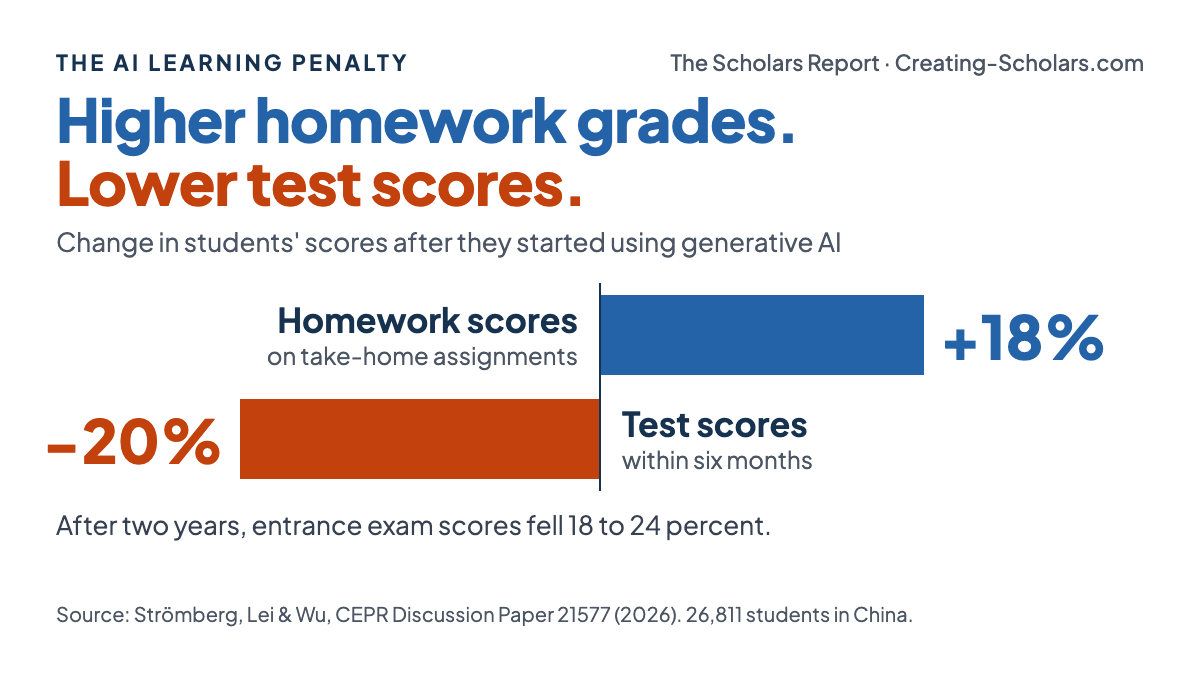
Homework grades can hide the problem. A large study released this year shows how. Economists from Stockholm University and the University of Hong Kong followed 26,811 secondary school students in China for 30 months as generative AI went from almost unused to used by about 80 percent of them. Once students started using AI, homework scores rose 18 percent and homework time dropped by about 30 percent. But within six months, their exam scores fell 20 percent. Over two years, scores on high school and college entrance exams fell 18 to 24 percent.
The researchers found that about four out of five students using AI finished homework faster than even the fastest students working alone, and they earned very high scores. They were letting AI do the work, and their exam results showed it. The one in five who used AI but still spent real time on their homework did about as well on exams as students who didn't use AI at all. Surprisingly, the losses were largest among students who had been top performers before they started using AI.
The study's own title says it plainly: "The Generative AI Learning Penalty." An earlier study of nearly 1,000 high school math students in Turkey, led by researchers at the University of Pennsylvania's Wharton School, found the same pattern. Students given open access to ChatGPT did 48 percent better on practice problems and 17 percent worse on the exam. Students given an AI tutor designed to give hints instead of answers did no worse on the exam.
Watch the tests, not just the homework. A rising homework grade means little if test scores are slipping. If homework grades are high and test scores are falling, students are using too much AI and skipping too much thinking. Also notice how long homework takes. A student who finishes a night's work in a fraction of the usual time, with a perfect score, deserves a closer look. Teachers can help by giving frequent, short in-class quizzes on homework material, so everyone can see what a student has actually learned.
The Real Goal
The tools in education have changed. What makes a scholar has not. Children who learn to think will use AI well; those who don't will be left behind. The years from five to fifteen are when that thinking is built, and those years don't come back.
Tonight, sit down with your child, look at a recent assignment together, and ask the question that matters most: who did the thinking?
Sign up for The Scholars Report to get more practical guidance on raising scholars.