What Screen Time Is Really Doing to Your Child's Brain

“Keep your heart with all vigilance, for from it flow the springs of life.” — Proverbs 4:23
“My sixth graders behave like third graders,” bemoaned a teacher to me recently. “They just aren’t as smart, and they have the attention span of a five-year-old.”
“Kids just aren’t what they used to be. They just can’t learn anymore,” bemoaned another.
These are teachers with decades of experience who teach a select student body at a top prep school. And they are right.
Three numbers should trouble anyone who cares about the next generation’s mind.
For the first time in a century, IQ scores in the developed world have begun to slip: a Northwestern University analysis found that Americans’ ability scores fell in three of four major categories between 2006 and 2018—a reversal of the long-running steadily rising scores. Over the same span, sustained attention collapsed. UC Irvine researcher Gloria Mark documented that the average time a person maintains focus on a single screen dropped from about 2.5 minutes in 2004 to roughly 47 seconds by 2016. And adolescent despair climbed in step: by 2023, about 40 percent of U.S. high-schoolers reported persistent feelings of sadness or hopelessness, up from 30 percent a decade earlier, according to the CDC.
No single statistic proves a cause, and researchers rightly caution against sweeping conclusions—falling test scores may reflect changing habits as much as changing minds. But the trend lines bend downward across the very years the pocket supercomputer became a fixture of childhood, and the burden of explaining that convergence away grows heavier each year.
True education requires the formation of a child’s entire character, wisdom, and moral capacity—a historic principle rooted in the understanding that learning is far more than a sequence of technical inputs or informational compliance. Today, that formation faces a systematic, silent disruption—not from a lack of information, but from the excessive, unmonitored, algorithmic delivery of it. When a developing brain is exposed to unregulated screen time, the biological and psychological foundations that support cognitive stamina, emotional resilience, and deep conceptual thinking may be steadily eroded. To protect tomorrow’s scholars, parents and educators must engage the empirical evidence on how screens affect neural development—honestly, including its limits—alongside concrete, high-agency strategies to command technology rather than surrender to it.
Stunted Learning and Cognitive Degradation
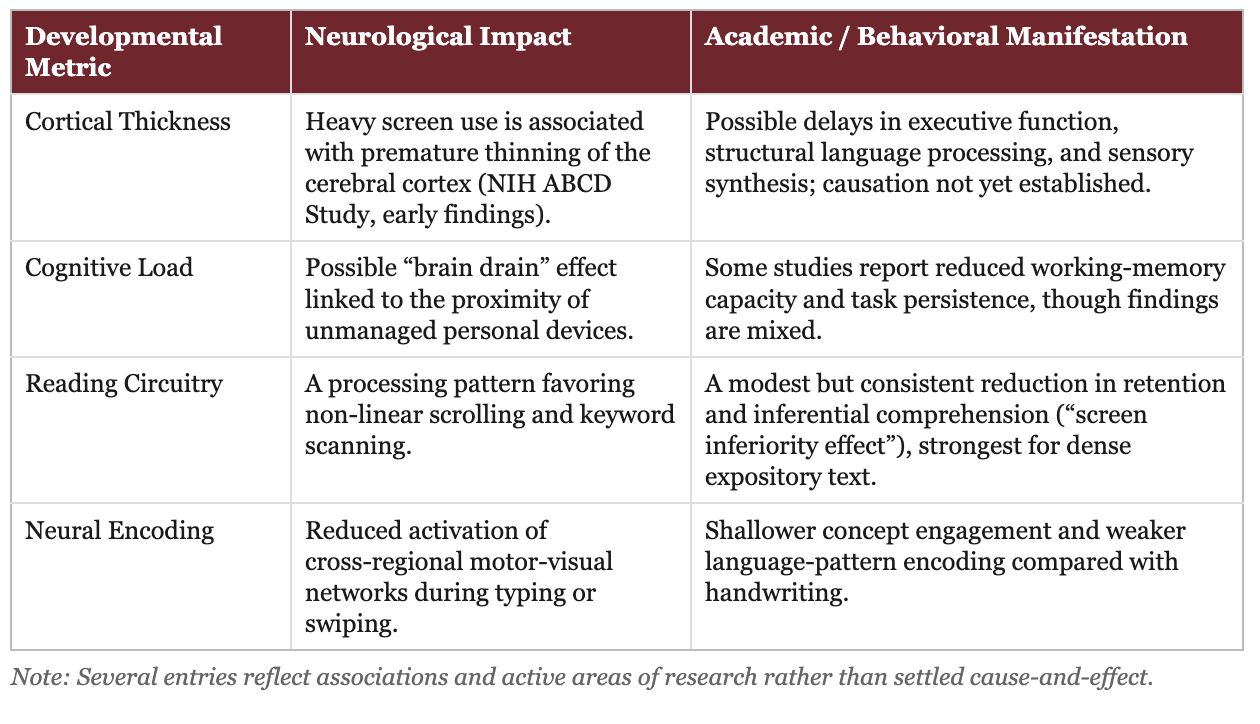
The developmental cost of early and excessive device use may be written into the physical architecture of the growing brain. Structural neuroimaging from the National Institutes of Health’s multi-year Adolescent Brain Cognitive Development (ABCD) study found that children who reported significant daily screen time showed premature thinning of the cerebral cortex—the outermost layer of the brain responsible for processing sensory information, language, and executive reasoning. It is important to note that these are early, correlational findings: researchers have cautioned that it is not yet established whether screens cause the thinning, or whether children already predisposed to such differences are simply drawn to screens more.
Even as the causal picture develops, several well-documented effects point in a consistent direction:
The Screen Inferiority Effect: Meta-analyses tracking reading comprehension—most notably Pablo Delgado — Universitat de València and colleagues’ review of 54 studies and more than 170,000 readers—find that people tend to comprehend and retain less when reading on screens than on paper. On screens, readers more readily default to non-linear skimming, scrolling, and keyword-spotting. The disadvantage is modest but consistent and well-replicated, and it is strongest for dense expository text and reading under time pressure.
Attentional Resource Depletion: Some research has described a “brain drain” effect, in which the mere presence of a personal smartphone within a student’s field of view may consume a portion of finite working memory—the subconscious effort of resisting the urge to check it drawing on energy needed for complex problem-solving. This effect is debated: an influential 2017 study reported it, whereas a subsequent replication failed to reproduce it. The prudent reading is that an unmanaged device nearby is, at best, a needless risk to focus.
Handwritten Processing Loss: Electroencephalogram (EEG) studies show that writing by hand activates broad, interconnected neural networks across the brain’s motor, visual, and cognitive regions—a rich sensory-motor experience largely absent during typing or swiping. When students rely on keyboards, the brain bypasses the precise motor sequencing that helps deeply encode language patterns and conceptual definitions into long-term memory.
Table 1. Neurological and Cognitive Effects Associated with Excessive Screen Exposure
Impaired Mental Health and Psychological Fragility
The rise in adolescent mental-health difficulties has coincided closely with the mass integration of algorithmic media into daily childhood routines. Unmonitored, portable screen access can act as a psychological destabilizer, turning behavioral-design vulnerabilities against sensitive developmental windows.
Dopamine Baseline Disruption: Social-media feeds and short-form video operate on variable reward schedules—the same intermittent-reward mechanism that underlies gambling’s pull. The unpredictable delivery of notifications, likes, and visual transitions triggers repeated dopamine spikes. Researchers suggest that, over time, this pattern pushes the brain to downregulate its dopamine response, raising the baseline stimulation a child needs to feel engaged and making ordinary environments—a quiet classroom, a long text, a physical book—feel flat by comparison.
Chronic Stress Activation: Unmonitored device access can trap children in a state of near-constant vigilance. Researchers propose that the steady anticipation of digital feedback keeps the body’s stress-response system overactive, thereby sustaining elevated cortisol levels. This ongoing physiological strain is thought to erode emotional regulation—showing up as heightened anxiety, low mood, and irritability when the stimulus is withdrawn. The mechanism is plausible and increasingly studied, though less firmly established than the findings on reading and sleep.
The Circadian Deficit: Late-night screen exposure suppresses the pineal gland’s production of melatonin through short-wavelength blue light, shortening and fragmenting sleep. Because sleep is when the developing brain consolidates memory and prunes neural connections, chronic disruption is thought to compound over time—impairing next-day emotional regulation and cognitive processing.
Tech-Forward Stewardship: Protection Without Ludditism
Protecting a child from digital degradation does not require retreat into isolation or a wholesale rejection of technological fluency. The goal of a forward-thinking parent is to build a framework within the home that models discipline, clear boundaries, and critical discernment.
Implement Network-Wide Content Filters: Rather than relying solely on invasive control software installed on a child’s device—which often breeds friction, resentment, and a desire to work around the rules—parents can secure the home at its source. Network-level DNS filtering (such as Cloudflare for Families or NextDNS) at the home router cleanly blocks adult content, aggressive data trackers, and manipulative platforms across every device on the network at once.
Enforce Hardware Function Isolation: Much of modern screen-time creep happens because a single device handles too many jobs. Parents can decouple daily utilities from entertainment-heavy platforms: if a child needs an alarm, buy a standalone clock; if they need audio for music or language study, use a device without an open web browser; if they read digitally, favor dedicated e-ink readers that lack app stores and browsing.
Grayscale De-incentivization: Digital interfaces are deliberately engineered with vibrant, saturated color to capture and hold attention. Parents can strip away much of that pull by switching the display to grayscale in the device’s accessibility settings. Removing the visual reward cues lowers a screen’s draw, turning it from an engaging playground back into a plain, utilitarian tool.
Classify Devices by Producer vs. Consumer Output: Technology is best judged by the kind of thinking it demands. Parents can draw a clear line between creative, high-agency use and passive, low-agency consumption. Programming tools, music-production software, 3D modeling, and serious research databases build intellectual discipline; social feeds, short-form video, and non-educational games fragment attention. Permit the former with structured latitude; gate the latter with uncompromising friction.
By anchoring the home in real boundaries and deliberate friction, parents do not cut their children off from the modern world. They give them a rare and profound advantage: an uncorrupted capacity for singular, sustained focus—the very ground on which wisdom, character, and deep learning are built.