The Founding Fathers' Education: The Blueprint for Future Scholars
Looking back at the creation of the United States it is almost impossible feat of collective genius. As the nation celebrates 250 years of independence, we naturally marvel at the monumental forces that transformed a loose collection of agrarian colonies into the world's leading industrial and technological powerhouse.
We study what they built, while often completely ignoring the parallel engine that made it possible: the unfair advantage of the colonial mind. The architects of America possessed a cognitive edge that has been systematically erased from the modern government classroom. The story of American education over the past two and a half centuries is a story of radical, sometimes dangerous adaptation. It is a timeline closely connected to global history, formed by intense spiritual convictions, molded by industrial demands, and formed by bitter battles for equal access.
When the thirteen colonies declared independence 250 years ago, only a few thousand men in a population of some 2.5 million held a college degree—a fraction of one percent. In fact, on the eve of the Revolution, there were only nine chartered colleges operating across British North America. These institutions, modeled closely on the ancient English universities of Oxford and Cambridge, focused primarily on a classical liberal arts curriculum to cultivate an educated clergy and maintain religious tradition.
The Nine Colonial Colleges of 1776
These pre-Revolutionary institutions established the initial framework for American higher education:
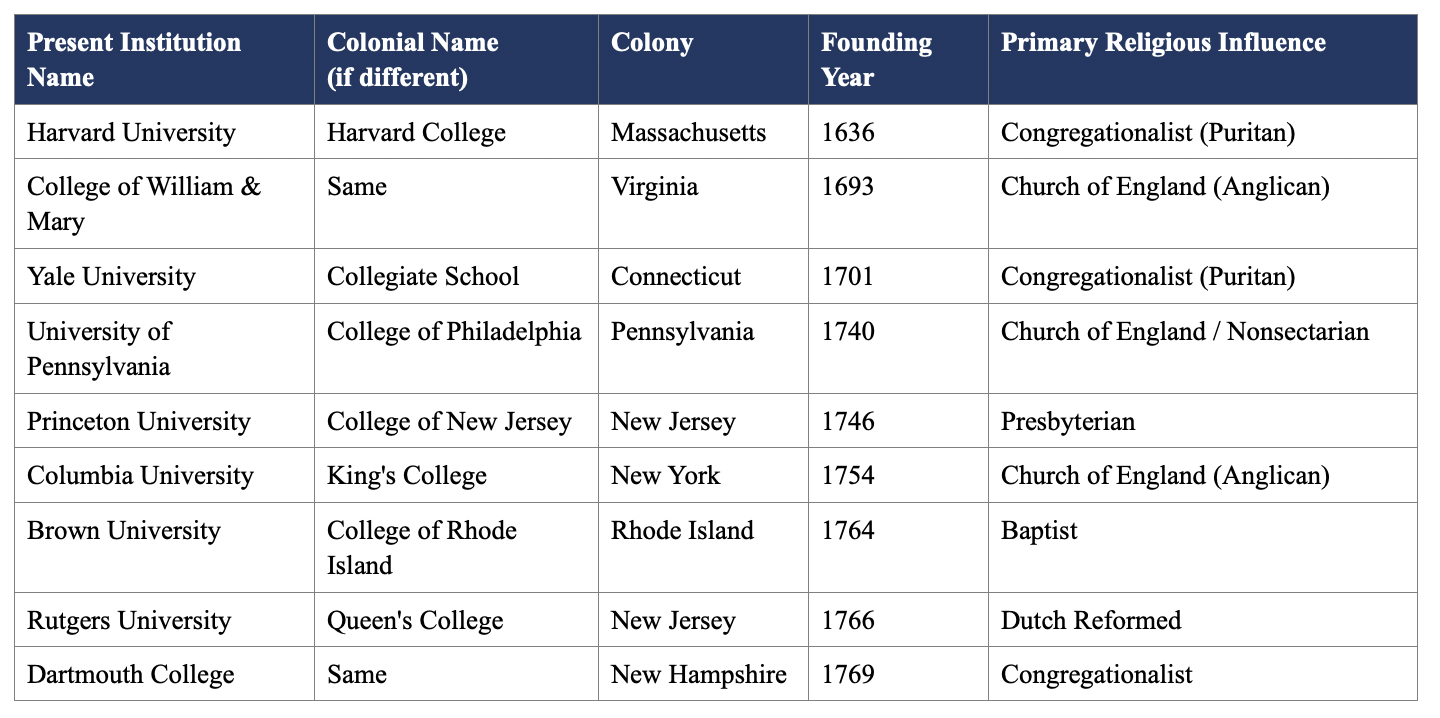
These nine colleges, and the classical, self-directed learning that surrounded them, produced a generation of uncommonly capable minds. Yet as we cross this 250-year milestone, much of that educational foundation has quietly disappeared from how we raise and teach our children. Before we can envision the next 250 years of learning, we have to understand what the first 250 actually built—how these scholars were admitted, what they studied, and how that training forged the men who, in turn, built a nation.
The 1776 Admissions Process
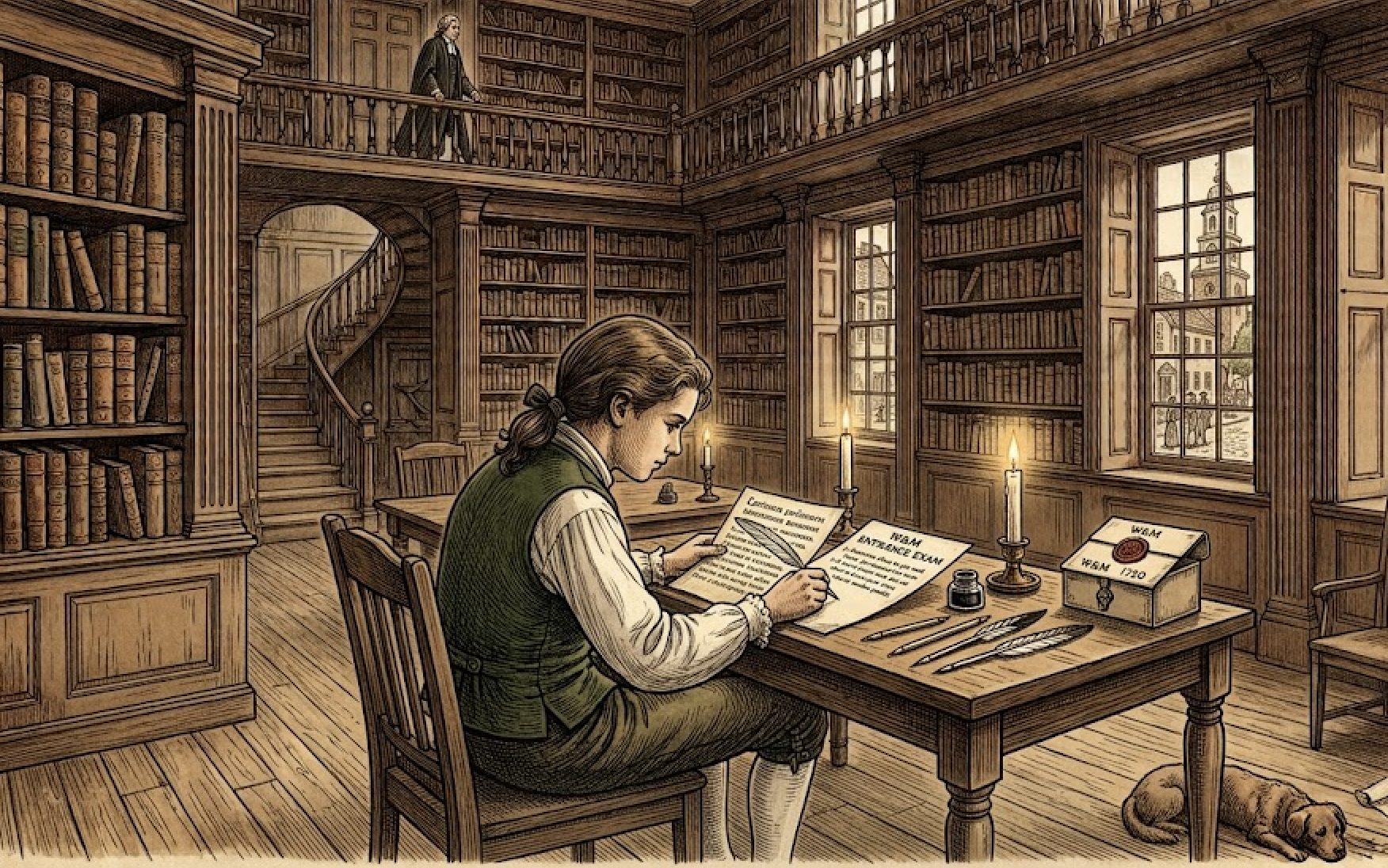
To gain entry into one of the nine colonial colleges in 1776, a candidate—often a boy between the ages of 11 and 16—faced a live, face-to-face academic interrogation. There were no written applications, standardized test scores, or holistic admission essays. Instead, applicants traveled directly to campus to sit in a closed room with the College President and a panel of senior tutors, where their enrollment hung entirely on their ability to prove strict mental and language competence on the spot.
Functional fluency in classical languages was the key to admissions. To pass this live gauntlet, applicants were required to convert complex Latin texts from Cicero and Virgil extempore (at sight), read the authentic Greek text of the New Testament Gospels, and perfectly parse intricate grammatical structures under rapid-fire questioning. They even had to compose grammatically flawless Latin prose on the spot to prove they could actively construct the language, rather than just passively decode it.
Beyond linguistics, the prerequisites of 1776 required basic quantitative competency in "vulgar arithmetic"—including fractions, long division, and the commercial proportions used in colonial trade. Once an applicant proved their intellectual merit, the final entry thresholds were strictly behavioral and financial: a formal certificate of "good moral character" from a local minister, an upfront matriculation fee, and a legally binding financial bond signed by a wealthy guarantor to secure their seat.
The Classical and Spiritual Foundations
Long before massive government bureaucracies oversaw education, American learning was decentralized, localized, and explicitly based in Christian values. The early colonists did not view education merely as a tool for economic advancement, but as an essential requirement for spiritual autonomy and civic responsibility.
The bedrock of this philosophy can be traced back to the Massachusetts Bay Colony’s famous "Old Deluder Satan Act" of 1647. The law required towns to establish schools specifically so that citizens could read Scripture for themselves, operating under the conviction that systematic ignorance was an obstacle to spiritual truth. Higher education followed an identical paradigm: America’s foundational colonial colleges were established primarily to train ministers and preserve theological and classical learning.
The Spiritual Roots of the American Mind
To understand how the Founders thought about freedom and government, you have to understand the Christian intellectual world that formed them. Even the founders who weren't conventionally religious knew the Bible intimately and reasoned in its terms. That shared inheritance shaped the blueprint of the United States in three major ways:
The Idea that People are Selfish: The Founders were taught that human beings are naturally imperfect and easily corrupted by power. Because they didn't trust any single person with absolute control, they created checks and balances. They split the government into different branches so that "ambition could counteract ambition" and leaders could keep an eye on each other.
Rights Come from a Higher Power: The Founders believed in the concept of Imago Dei, which holds that everyone is created in the image of God. Because of this, they argued that our basic rights come directly from a Creator, not from a king. Since a king didn't give you your rights, a king had no power to take them away.
Government is a Sacred Promise: They based the idea of a written Constitution on biblical covenants (sacred promises between God, a leader, and the community). They didn't see the Constitution as just a regular legal contract; they saw it as a holy agreement that required absolute honesty and compliance.
Ultimately, this educational model taught the Founders a simple rule: if you want a country to enjoy political freedom on the outside, its citizens need to have strong moral control on the inside.
The Founders' Educational Pedigrees
The architects of the American Revolution were products of this classical culture, though their formal schooling varied enormously—and that variation is the point. Jefferson, Adams, and Madison completed the full college course and read Greek and Latin fluently; Hamilton and Jay started college but were cut short; and several of the most consequential—Washington, Franklin, Henry, and Mason—had little or no higher education at all, building their intellects through apprenticeship, self-directed reading, and relentless practice. What these men shared was not a credential but a way of learning: rigorous, classically grounded, morally serious, and self-driven. That is also why the founders here reach beyond the household names to figures like William Richardson Davie, Abraham Baldwin, Benjamin Rush, and John Dickinson—less remembered today, but the men who built new colleges that carried this model forward.
Thomas Jefferson
Completed College / Higher Education / Founder of the University of Virginia
Jefferson received an elite classical education, learning Latin, Greek, and French at a young age. He attended the College of William & Mary from 1760 to 1762, immersing himself in the classical liberal arts—the trivium (grammar, rhetoric, logic) and the quadrivium (arithmetic, geometry, astronomy, music) inherited from medieval European cathedral schools. Jefferson read classical Greek and Latin fluently, drawing directly from ancient historical cases to draft the Declaration of Independence.
Jefferson organized his expansive intellectual life around three definite figures. He commissioned portraits of John Locke, Sir Francis Bacon, and Sir Isaac Newton, and hung them prominently in his collection, referring to them as "the three greatest men that have ever lived, without any exception." He structured his entire philosophy of reason, liberty, and human nature upon their scientific and empirical foundations. This structure was visible in his personal library at Monticello, which eventually became the essential core of the Library of Congress. Jefferson organized his vast catalog using Francis Bacon’s categorization of human knowledge: Memory (History), Reason (Philosophy/Science), and Imagination (Fine Arts). He approached learning with a structured, custom-designed revolving bookstand that held five open texts simultaneously, allowing him to conduct cross-disciplinary research at a single glance. Later in life, he established his educational legacy by founding the University of Virginia and designing its architectural curriculum as an "academical village" centered on a great library rather than a chapel.
John Adams
Completed College / Higher Education / Disciple of Cicero
Adams entered Harvard College in 1751 at age sixteen. His curriculum was firmly grounded in the classical tradition, with a heavy emphasis on arithmetic, logic, rhetoric, and ancient languages. He graduated with a Bachelor of Arts in 1755 and later earned a Master of Arts.
Adams's Harvard education grounded him in logic and natural philosophy, but his real intellectual awakening came in 1758, while he was reading law in Boston. Searching for a secular model of public service, he anchored himself to the Roman lawyer and statesman Marcus Tullius Cicero—"Tully" to 18th-century colonials. When arguments or anxieties flared, Adams wrote in his diary that he would "take up Tully to compose myself." He patterned his own rhetoric on Cicero's, most visibly in his defense of the British soldiers after the Boston Massacre. Deeper still, Cicero's De Legibus and Polybius's analysis of the Roman constitution gave Adams his lifelong conviction that lasting stability required a mixed government balancing monarchic, aristocratic, and democratic elements. He carried that Roman defense of checks and balances directly into his 1776 Thoughts on Government, which shaped the Massachusetts Constitution and, in turn, the U.S. Constitution.
James Madison
Completed College / Higher Education / America's First Graduate Student
Madison was educated by private tutors before enrolling at the College of New Jersey (now Princeton University) in 1769. He completed his entire bachelor's degree in just two years through intense, round-the-clock study.
Following his graduation in 1771, Madison remained at Princeton for about six more months to study under President Witherspoon, which is why he's often called the university's first graduate student. He stayed to study political philosophy and Hebrew under the direct tutelage of Princeton's president, John Witherspoon, a Scottish Presbyterian minister and Calvinist theologian. Witherspoon's lectures on moral philosophy and common-sense realism made a lasting impression on Madison’s worldview. Witherspoon's theological framework held that, because human nature was inherently fallen and self-interested, no simple form of government could rely solely on civic virtue. Madison directly translated this theological realism into the architectural framework of the United States Constitution, engineering a system of checks and balances and competing factions meant to harness flawed human motivation for the common good.
Alexander Hamilton
Attended College / Student of English Common Law
Hamilton attended a preparatory school in New Jersey to master Latin and Greek before enrolling at King’s College (now Columbia University) in 1774. His formal studies in medicine, law, and politics were cut short by the outbreak of the Revolutionary War in 1775, when he left to join the military.
Born into obscurity in the West Indies, Hamilton had only a piecemeal early education until local benefactors, impressed by his precocious clerking and writing, funded his passage to New York. The war cut short his studies at King's College, but he continued to read in political economy and military logistics during his years as Washington's aide-de-camp. Afterward—exempted from the usual multi-year clerkship because the war had interrupted his schooling—he crammed English common law in roughly six months of self-directed study, working mainly from Sir William Blackstone's Commentaries. From Blackstone, he took a lasting belief that property rights, commercial stability, and strong central authority underpinned a functioning society. He drew on that framework to write the majority of the Federalist Papers, and as the first Secretary of the Treasury, he built the young nation's financial system—the First Bank of the United States, a structured national debt, and the basis for a national market economy.
John Jay
Completed College / Higher Education / Huguenot Jurist
Jay was tutored privately in grammar and classics before entering King's College at age fourteen in 1760. His rigorous education focused on classical literature, logic, rhetoric, and law, opening the way to a highly prestigious legal apprenticeship under Benjamin Kissam.
Jay was raised in a wealthy New York merchant family of Dutch and French Huguenot descent. His paternal ancestors had fled brutal religious persecution in France following the 1685 revocation of the Edict of Nantes, which stripped Protestants of their legal and civil rights. This ancestral trauma deeply colored Jay’s early education; his mother home-schooled him until age eight, after which he was sent to study under a French Huguenot pastor in New Rochelle. Entering King's College, Jay developed a precise command of Latin, Greek, and legal rhetoric. Jay’s unique exposure to European history and the devastating outcomes of unchecked state tyranny made him the legal anchor of early America. He served as a co-author of the Federalist Papers and was the primary architect of New York’s first state constitution. Because of his precise, methodical understanding of international law and treaty mechanics, Washington appointed him the first Chief Justice of the United States Supreme Court. Jay’s judicial philosophy established that international treaties and the "law of nations" were bound to the Constitution as the supreme law of the land, structurally guaranteeing that the young republic could command legal legitimacy in the international arena.
John Hancock
Completed College / Higher Education / Merchant Apprenticeship
Hancock attended the Boston Latin School, where he was thoroughly grounded in classical texts. He later entered Harvard College at age fourteen, graduating in 1754 with a classical degree that prepared him to enter the mercantile business of his wealthy uncle.
Following the early death of his father, Hancock was adopted by his uncle, Thomas Hancock, one of the wealthiest transatlantic shipping merchants in Boston. Hancock’s education was explicitly dual-track: he was trained in classical texts at Boston Latin and completed his formal bachelor’s degree at Harvard. However, his most consequential education occurred immediately after graduation, when he entered an exacting, hands-on apprenticeship inside his uncle's corporate house. He was immersed in the realities of international trade, currency fluctuations, British imperial customs, and shipping logistics, eventually inheriting the entire commercial empire in 1764. Unlike his deeply philosophical peers, such as Madison or Jefferson, Hancock’s intellect was commercial, logistical, and localized. When British revenue acts, such as the Stamp Act and the Townshend Acts, began choking colonial shipping, Hancock recognized that British economic policies were designed to subjugate American merchant independence. His elite commercial literacy allowed him to effectively bankroll the early Patriot movement, using his vast wealth to fund resistance networks. His logistical skill made him the choice to serve as President of the Second Continental Congress, where his administrative stability guided the colonies through the chaotic execution of the war. His iconic, bold signature on the Declaration of Independence was a defiant manifestation of a man who fully understood the commercial and personal stakes of treason against the Crown.
George Mason
Private Tutoring / Extensive Self-Education
Mason never attended a formal college or university. Following his father's death, he was raised by his uncle, John Mercer, who owned one of the largest private libraries in colonial Virginia, with over 1,500 volumes.
Under the guidance of private tutors and through decades of obsessive, self-directed reading in Mercer's library, Mason mastered English history, classical philosophy, and law. Bypassing institutional classrooms, Mason's crucible was entirely literary. He spent decades inside Mercer’s library tracking the long evolution of English liberty, from the Magna Carta to the English Bill of Rights of 1689. This self-directed immersion enabled him to clearly conceptualize inherent human rights before they were codified nationally, culminating in his authorship of the landmark Virginia Declaration of Rights—the document that served as the primary model for America's Bill of Rights.
Patrick Henry
Minimal Formal Schooling / Private Tutoring (Self-Directed Law)
Henry went to a local schoolhouse for basic literacy before being tutored directly by his father, John Henry, a well-educated Scotsman who trained him in Latin, Greek, mathematics, and ancient history. Despite this strong home-based foundation, Henry struggled to find his career footing as a merchant and planter, eventually pivoting to the law.
Henry was entirely self-taught in legal studies, famously reading the law for just a few months on his own. His crucible was not the quiet library, but the human theater of the courtroom and the local tavern. He had an innate grasp of human nature and a raw, unparalleled rhetorical genius that allowed him to pass his bar exam with minimal formal training, instantly converting his classical historical knowledge into fiery, populist oratory that sparked the revolutionary spirit throughout the colonies.
George Washington
Local Schooling / Expansive Self-Directed Library
Unlike Jefferson or Adams, Washington never attended college or learned classical languages. His formal education ended around age fifteen at a local school in Virginia, where he focused entirely on practical, vocational skills: penmanship, commercial arithmetic, geometry, and land surveying.
However, Washington spent the rest of his life aggressively compensating for this lack of formal schooling. He built an expansive personal library at Mount Vernon that grew to more than 1,200 titles, spanning agriculture, military strategy, history, and political philosophy. Driven by a deep commitment to self-improvement, Washington became a prolific writer, penning tens of thousands of detailed letters, journals, and official dispatches throughout his life. His beautiful, clear penmanship and precise writing style became a physical manifestation of his self-directed intellectual discipline and continuous self-education.
Benjamin Franklin
Minimal Formal Schooling / Founder of the Academy of Philadelphia / Honorary Doctorates from Oxford & St. Andrews
Franklin represents America’s foundational blueprint for the self-directed scholar. With only two years of formal schooling at Boston Latin and a local writing school, Franklin's formal education ended at age ten due to monetary constraints. He entered a printing apprenticeship at twelve, using access to books to aggressively teach himself grammar, logic, multiple languages, and advanced science.
As a young, self-taught printer, Franklin’s philosophical awakening was deeply formed by the writings of John Locke, specifically Locke's An Essay Concerning Human Understanding. Locke’s empiricist theory that the human mind begins as a blank slate (tabula rasa) and gathers knowledge strictly through experience, observation, and reason profoundly validated Franklin's own unconventional, non-institutional path to learning.
Driven by these practical ideals, Franklin went on to found the Academy and College of Philadelphia in 1751 (which would later evolve into the University of Pennsylvania). Rejecting traditional sectarian models, Franklin designed the academy to concentrate on practical, interdisciplinary education—teaching mercantilism, history, and the natural sciences to prepare students for active public service and business.
When Franklin's groundbreaking electrical experiments were later published in Europe, the international scientific community stood transfixed. Although he never attended college as a youth, the ancient universities of Great Britain recognized his immense intellectual achievements by conferring their highest honors upon him. In 1759, the University of St. Andrews in Scotland awarded him an honorary Doctor of Laws, and in 1762, the University of Oxford in England granted him an honorary doctorate. It was from these European institutional accolades that he proudly assumed the lifelong title of "Doctor Franklin."
During his years in London in the 1760s and early 1770s, Franklin moved in the overlapping circles of the British and Scottish Enlightenment and was acquainted with Adam Smith, the father of modern economics. Smith settled in London around 1773 to finish The Wealth of Nations, and the two men are known to have crossed paths before Franklin returned to America in 1775. Franklin was a rich source on the American colonies—their explosive population growth and commercial life—subjects central to Smith's argument —and a later (second-hand) account claims that Smith shared chapters of the manuscript with Franklin and other friends for comment. That story is often repeated but poorly documented, so it's best treated as plausible tradition rather than established fact. What's clear is that Smith's landmark defense of free markets and his critique of British imperial mercantilism drew on exactly the kind of colonial evidence Franklin embodied.
William Richardson Davie
Completed College / Higher Education / Father of the University of North Carolina
Born in northern England, Davie moved to South Carolina as a child and was educated locally before entering the College of New Jersey (now Princeton University). He graduated with honors in 1776, thoroughly trained in the classical arts, logic, and moral philosophy. Following graduation, he moved to North Carolina to study law as an apprentice under Spruce Macay, a legal training path that was interrupted by his distinguished military service as a cavalry officer in the Revolutionary War.
Davie’s educational pedigree directly shaped his vision for institutional structural reform. Believing that a broad, generous education was mandatory for a stable and thriving democracy, he leveraged his post-war political status as a prominent Federalist delegate to the 1787 Constitutional Convention. In 1789, he introduced and successfully guided the legislative bill that established the University of North Carolina—making it the first state university to open its doors to students. Davie served on the university's Board of Trustees for nearly two decades, explicitly making sure that public higher education became an engine for democratic civic leadership.
Benjamin Rush
Completed College / International Higher Education / Pioneering Transatlantic Physician
After his father's early death, Rush was sent at age eight to live with an aunt and uncle and enrolled in his uncle's academy, where he encountered the tenets of the Great Awakening. He performed well academically, entering the junior class at the College of New Jersey (Princeton) and graduating in 1760 at the age of just fourteen. He spent five years apprenticing under Dr. John Redman in Philadelphia while taking lectures at the College of Philadelphia, before traveling to Scotland to earn his medical degree from the world-renowned University of Edinburgh in 1768. He completed his clinical training in London and Paris, where he established a lifelong friendship with Benjamin Franklin.
Rush directed his deeply religious upbringing and elite medical training into radical structural reform. Returning to Philadelphia, he became the first professor of chemistry in North America. Beyond medicine, Rush was a tireless advocate for universal public schooling on every level, arguing that no republic could remain secure without a well-informed constituency of both men and women. His belief that institutional expansion was vital on the American frontier led him to push for and secure the founding of Dickinson College in Carlisle, Pennsylvania. He was an early, outspoken champion for the abolition of slavery, prison reform, and the establishment of a national university. He also famously encouraged Thomas Paine to write on the subject of American liberty, even suggesting the title for Paine's historic pamphlet, Common Sense.
Abraham Baldwin
Completed College / Higher Education / Architect of State-Funded Education Systems
Born to a blacksmith with a large family, Baldwin's father borrowed money to send him to Yale College, where he studied theology and graduated in 1772. He remained at Yale as an institutional tutor until 1779, when he left to serve as a chaplain in the Continental Army. After the war, he turned down a distinguished position as Professor of Divinity at Yale to study law, successfully qualifying for the Connecticut bar in 1783.
Baldwin relocated to Georgia at the urging of General Nathanael Greene and Governor Lyman Hall (a fellow Yale alumnus). Hall tasked Baldwin with drafting a comprehensive educational master plan for Georgia’s secondary and higher education. Baldwin firmly believed that education was the foundation of civilization on the frontier, stating that society must instruct its youth to mold them "to the love of Virtue and good Order." He drafted the charter for the University of Georgia, which was approved in 1785, making Georgia the first state to grant a charter for a state-supported university. Baldwin served as the institution's first president during its structural planning phase, architecturally modeling its inaugural campus buildings and campus framework after his beloved alma mater, Yale.
John Dickinson
Private Tutoring / Transatlantic Legal Apprenticeship / "Penman of the Revolution"
Born to a wealthy planter family in Maryland, Dickinson was educated entirely at home by private tutors until age eighteen. He then moved to Philadelphia to pursue an intensive, traditional legal apprenticeship under prominent attorney John Moland. Seeking the apex of legal training, Dickinson traveled to London in 1753 to spend four years completing his legal education at the Middle Temple inside the historic Inns of Court and Westminster.
Dickinson’s deep immersion in English common law and constitutional history turned him into one of early America's most precise and influential essayists. Returning to Philadelphia, he established a dominant legal practice and wrote Letters from a Farmer in Pennsylvania, which brilliantly outlined the legal arguments against English taxation without representation and earned him an honorary law degree from Princeton. Despite his cautious, reserved stance—abstaining from voting on the Declaration of Independence in a final effort to achieve peaceful reconciliation—his mastery of governance made him indispensable. He helped draft the Articles of Confederation, served as president of both Delaware and Pennsylvania, and was a principal framer of the 1787 Constitution. His educational legacy was cemented in 1783 when Benjamin Rush named Pennsylvania's newly chartered frontier college "Dickinson College" in honor of John's immense contributions to the structural framework of American liberty.
Reclaiming the Unfair Advantage: The Way Forward for Tomorrow's Scholars
The men who engineered the American republic did not succeed because they retained the right answers for a standardized exam. They succeeded because they had an intellectual infrastructure that allowed them to synthesize deep history, command complex systems, and execute high-stakes logistics under immense pressure. They didn't pass through a factory conveyor belt; they built their own ways through intense self-direction, deep classical structures, and rigorous moral conviction.
Today's industrial model of government schooling does the opposite—it rewards compliance over interest, and memorization over judgment. As we transition into an AI-driven world, following instructions and reciting facts is exactly the work machines do best. The edge now belongs to what the Founders had: the ability to reason from first principles, untangle unfamiliar problems, and build what doesn't yet exist.
This is the exact mission behind the Creating Scholars Series and the Scholars Plan. We are not trying to help children comfortably fit into an outdated, fracturing system. Instead, we are giving future-focused parents and educators the tools to resurrect a tailored, multi-track, and deeply rigorous approach to learning. The next epoch will not be led by those who mastered standardized compliance—it will be led by true scholars who know how to build. It’s time to stop teaching our children what to think and finally give them the ultimate unfair advantage of learning how to think.